


The Ultimate Technical Comparison: Peruvian Pima Cotton vs. Standard Cotton
Walk into any high-street shop, and you will see the label "100% Cotton" everywhere. However, in the world of textile engineering, this label tells you very little about the actual quality, longevity, or feel of a garment. Not all cotton is created equal, and when it comes to premium loungewear, understanding the technical differences between standard cotton and Peruvian Pima cotton is the key to making a true investment in your wardrobe.
For those who value the principles of 'Quiet Luxury', the true marker of a high-end garment is not a designer logo, but the intrinsic quality of the fibre and the mastery of its construction. Let us break down exactly why Peruvian Pima stands in a league of its own.
The Anatomy of the Fibre: Why Length Changes Everything
The fundamental difference between cottons lies in the staple length of the fibre.
Standard cotton, used in mass-market fast fashion, consists of short fibres. When these short fibres are spun into yarn, there are countless microscopic ends sticking out. After just a few trips through the washing machine, these ends break and tangle together. This is what causes pilling (those small, rough bobbles) and that stiff, scratchy feeling over time.
Peruvian Pima cotton, grown in the coastal valleys of northern Peru, is classified as an Extra-Long Staple (ELS) cotton. Its fibres are significantly longer, smoother, and stronger than conventional cotton. Because the fibres are long and continuous, the resulting yarn is incredibly silky and highly resistant to breaking. A garment made of Pima cotton will not pill; instead, it maintains a luxurious, smooth surface year after year.
Furthermore, Peruvian Pima is harvested entirely by hand. Machine harvesting, common with standard cotton, tears the fibres and introduces impurities. Hand-harvesting preserves the pristine length and structural integrity of every single cotton boll.
The Engineering of Softness: What Does Interlock 50/1 Mean?
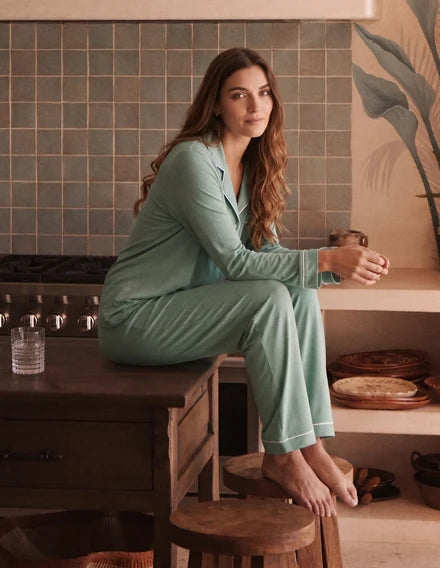
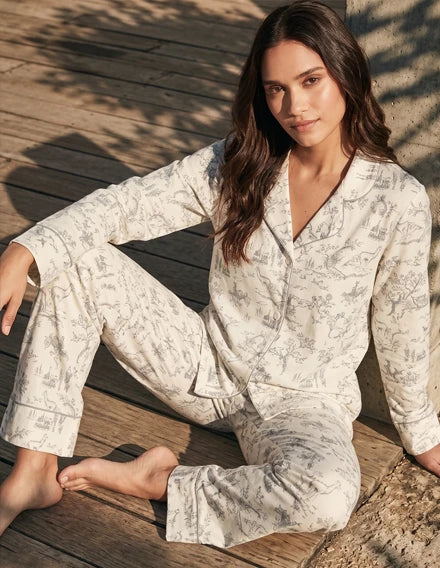
A superior fibre requires superior construction. At Inka Fabric, we do not use basic jersey knits; we engineer our pyjamas using an Interlock 50/1 construction. But what does this technical specification actually mean for your sleepwear?
50/1 Yarn Count: The number "50" refers to the fineness of the yarn. A 50/1 yarn is exceptionally fine and lightweight, requiring the highest grade of Pima cotton to spin without breaking. This results in a fabric that feels astonishingly soft against the skin.
The Interlock Knit: Standard t-shirts use a single-knit technique, which has a distinct front and back, and often curls at the edges. Interlock is a sophisticated double-knit technique. It interweaves the yarns so that both sides of the fabric are completely smooth and identical.
The combination of 50/1 yarn and an Interlock knit creates a fabric with a substantial, elegant drape. It is completely opaque, highly durable, and moves fluidly with your body, acting as a breathable second skin.
The Aesthetic of 'Quiet Luxury': Colour and Retention
True luxury whispers. It is an aesthetic defined by minimalism, exceptional quality, and an understated elegance.
Because Peruvian Pima cotton is highly absorbent, it takes to dyes much more effectively than standard cotton. This allows us to achieve deep, rich, and perfectly saturated hues without the use of harsh, degrading chemicals. Our organic colour palette—featuring sophisticated olive green, terracotta, and sand tones—remains vibrant and true. Standard cotton often fades and looks worn after a single season; Pima cotton retains its depth of colour, ensuring your loungewear looks as refined on day one hundred as it did on day one.
Sustainability: The Cost of Longevity
Standard cotton represents the ethos of disposable fashion: buy cheap, wear briefly, discard when it loses its shape.
Peruvian Pima cotton is the antithesis of this cycle. Because the Interlock fabric is so structurally sound and the ELS fibres are so resilient, these pyjamas will not warp, thin out, or lose their pristine finish. Investing in one exceptional set of Pima pyjamas eliminates the need to constantly replace inferior garments, making it a genuinely sustainable choice for the conscious consumer.
Summary: The Technical Breakdown
| Feature | Peruvian Pima Cotton (Interlock 50/1) | Standard Conventional Cotton |
|---|---|---|
| Fibre Type | Extra-Long Staple (ELS) | Short Staple |
| Harvesting Method | Hand-harvested (Preserves fibre integrity) | Machine-harvested (Damages fibres) |
| Texture & Feel | Exceptionally smooth, buttery, and cool | Initially soft, becomes rough with washing |
| Pilling Resistance | Extremely high (Does not pill) | Low (Prone to bobbling quickly) |
| Fabric Structure | Double-knit (Identical on both sides, heavy drape) | Single-knit (Prone to curling and warping) |
| Colour Retention | Excellent (Absorbs dyes deeply and evenly) | Poor (Fades quickly after washing) |
Frequently Asked Questions (FAQ)
Why are Peruvian Pima cotton pyjamas considered an investment?
Due to the extra-long staple (ELS) fibres, Peruvian Pima cotton has an exceptionally long lifespan. Unlike standard cotton that loses its shape, pills, and fades within a few months, an Interlock 50/1 Pima garment will maintain its structural integrity, vibrant colour, and extreme softness for years, offering a much lower cost-per-wear.
Does Pima cotton shrink in the wash?
While all natural fibres have a slight tendency to contract, high-quality Pima cotton woven in an Interlock structure is highly dimensionally stable. To preserve the fit and the fibres, always wash in cold water on a delicate cycle and avoid high-heat tumble drying.
Is Pima cotton suitable for the British climate?
Yes, absolutely. The Interlock 50/1 construction provides a substantial, comforting weight that is perfect for British evenings. At the same time, because it is a highly breathable natural fibre, it actively thermoregulates, keeping you warm in the winter without causing overheating or night sweats during milder months.